

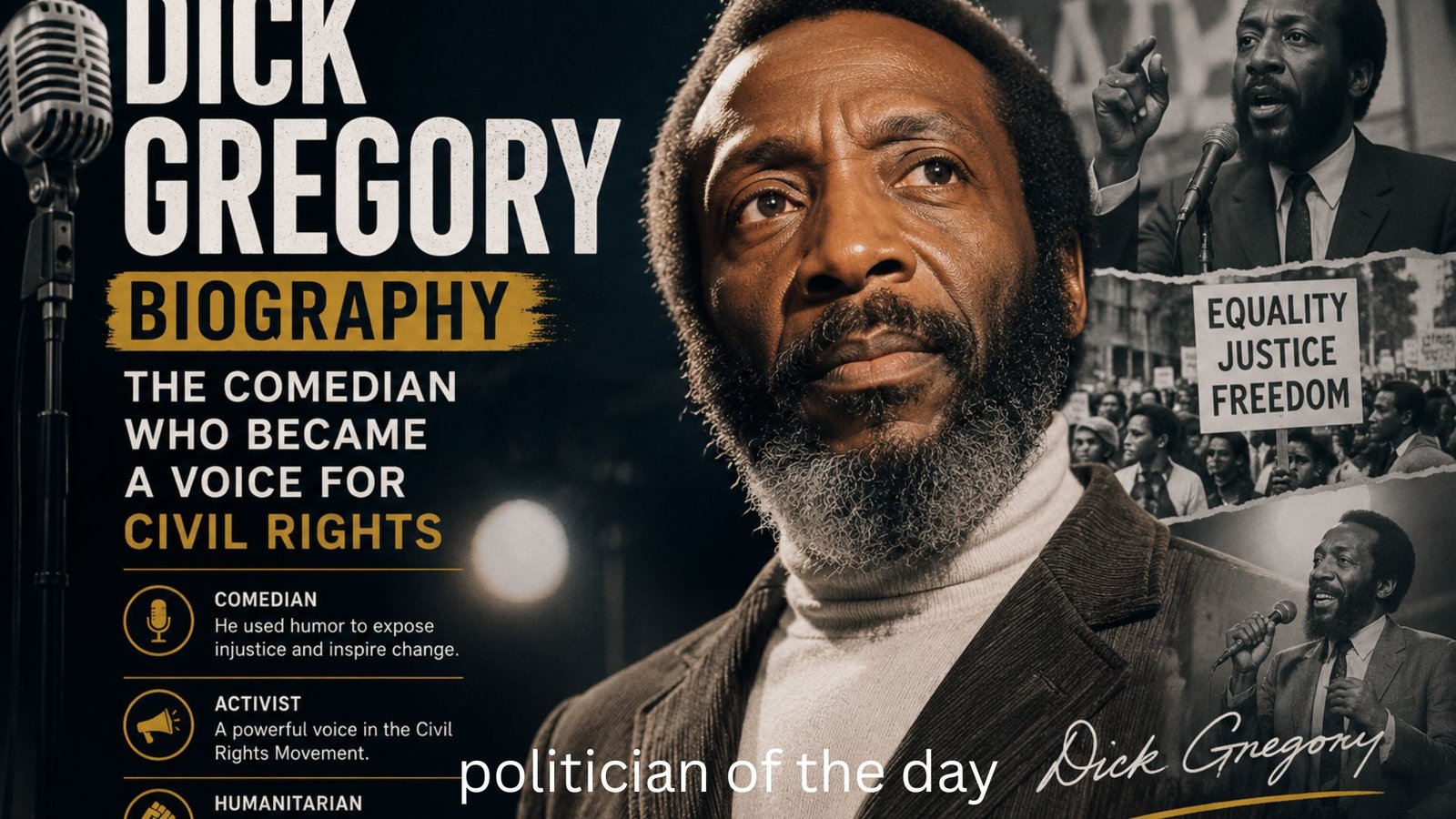
Dick Gregory Biography: The Comedian Who Became a Voice for Civil Rights
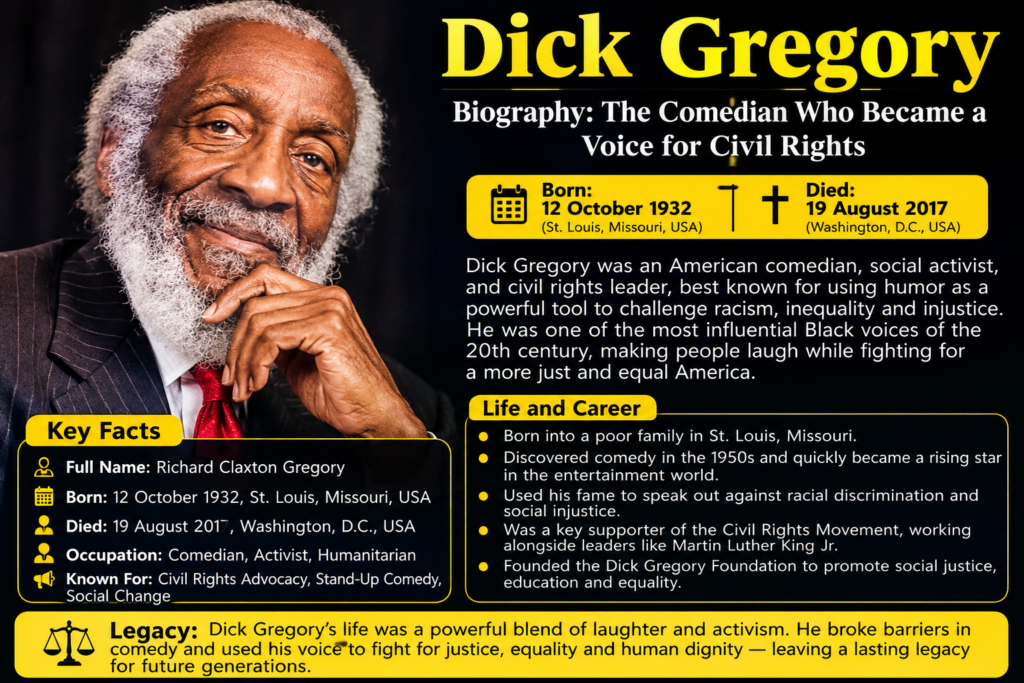
As we know, some public figures cannot be placed into a single box, and Dick Gregory is one of the clearest examples of that. He is remembered as a groundbreaking comedian, but underneath the humor was a man who spent decades fighting for civil rights, running for political office, and speaking out on issues that most entertainers of his time avoided. His death on August 19, 2017, closed the chapter on one of the most unusual and influential careers in American public life.
Early Life in St. Louis
Richard Claxton Gregory was born on October 12, 1932, in St. Louis, Missouri. He grew up in deep poverty after his father left the family, leaving his mother to raise the children alone while working long hours as a maid. Despite these hardships, Gregory found an outlet in athletics and academics. He earned a track scholarship to Southern Illinois University in 1951, where he became a standout middle distance runner and was later named the school’s top student athlete.
Breaking Into Comedy
After a stint in the United States Army, Gregory returned to Chicago hoping to break into the national comedy scene. His big moment came in 1961 when a performance at the Chicago Playboy Club, originally meant to be a short set, turned into a 6 week engagement. That single appearance earned him a feature in Time magazine and a spot on The Jack Paar Show, launching him into the national spotlight almost overnight. What set Gregory apart from other comedians of the era was his willingness to speak directly to white audiences about race, poverty, and segregation, using sharp wit instead of anger to make his point land.
Stepping Into Civil Rights Activism
As his comedy career grew, so did his involvement in the civil rights movement. Gregory took part in numerous demonstrations and was arrested multiple times for civil disobedience, including a well-known arrest in Birmingham, Alabama, in 1963. He used his growing fame to draw attention to the movement, appearing at marches and rallies alongside other prominent activists of the time. For Gregory, comedy and activism were never separate pursuits. He often said his jokes were simply another way of telling the truth about America.
Running for Mayor and President
Gregory’s activism eventually pushed him toward electoral politics. In 1966, he ran for mayor of Chicago, challenging the political establishment in a city known for its powerful party machine. Two years later, in 1968, he took an even bigger step by running for president of the United States as the candidate of the Peace and Freedom Party. While he never came close to winning either race, both campaigns were driven by a genuine desire to force conversations about racism, poverty, and government accountability into the mainstream political discussion.
A Shift Toward Health and Nutrition
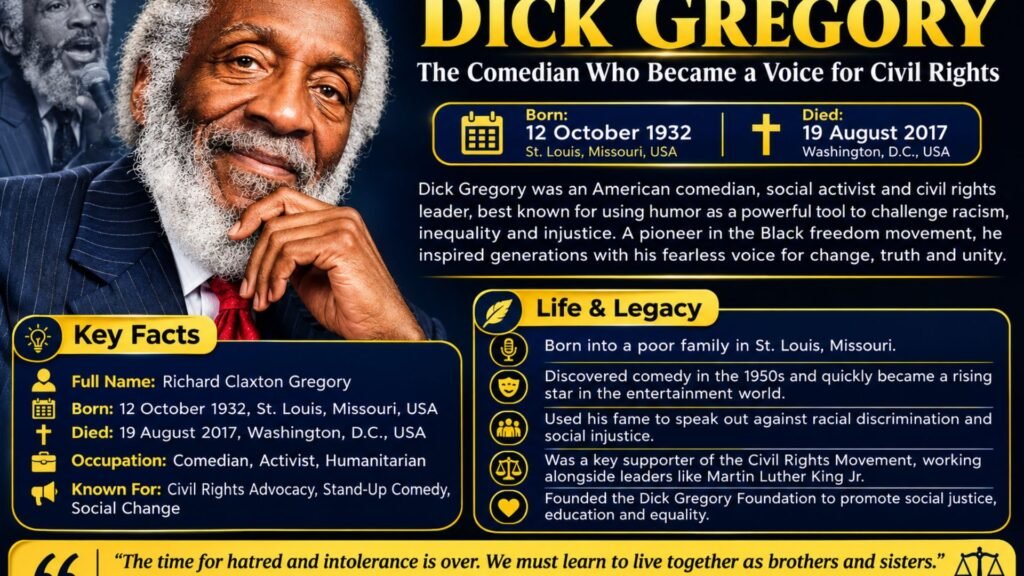
In the early 1970s, Gregory largely stepped back from stand-up comedy to focus more fully on his political and social causes, which by then had expanded beyond race relations to include hunger, capital punishment, drug abuse, and access to healthcare. He also became a passionate advocate for nutrition and healthy living, launching businesses and campaigns aimed at improving diets, particularly within Black communities. This later chapter of his life showed a man who was constantly evolving, always looking for new ways to make an impact beyond the comedy stage.
Facing Illness With His Own Philosophy
In 1999, Gregory was diagnosed with lymphoma. True to the independent spirit that defined his entire life, he chose to forgo traditional chemotherapy and instead relied on diet and alternative treatments, an approach that reflected the same nutrition-based philosophy he had spent years promoting. Remarkably, the cancer went into remission, and Gregory continued lecturing, writing, and speaking publicly for many more years afterward.
Final Years and Passing
Gregory remained active well into his eighties, continuing to write books and appear as a speaker on social and political issues. In August 2017, he was hospitalized in Washington, DC, after developing a severe bacterial infection. He passed away on August 19, 2017, at the age of 84, with his son Christian confirming the news to the public. Tributes poured in from politicians, entertainers, and civil rights leaders alike, reflecting just how far his influence had reached across different corners of American life.
Dick Gregory’s Lasting Legacy
Dick Gregory’s life resists easy categorization, and that is exactly what makes his story so compelling. He was a comedian who used laughter as a weapon against injustice, an activist who put his body on the line for civil rights, and a political candidate who ran not necessarily to win, but to make a point that could not be ignored. Decades after his breakthrough at the Playboy Club, his blend of humor, activism, and unapologetic honesty continues to be studied as one of the more unusual paths any public figure has taken in modern American history.