


Lyndon B Johnson August 27
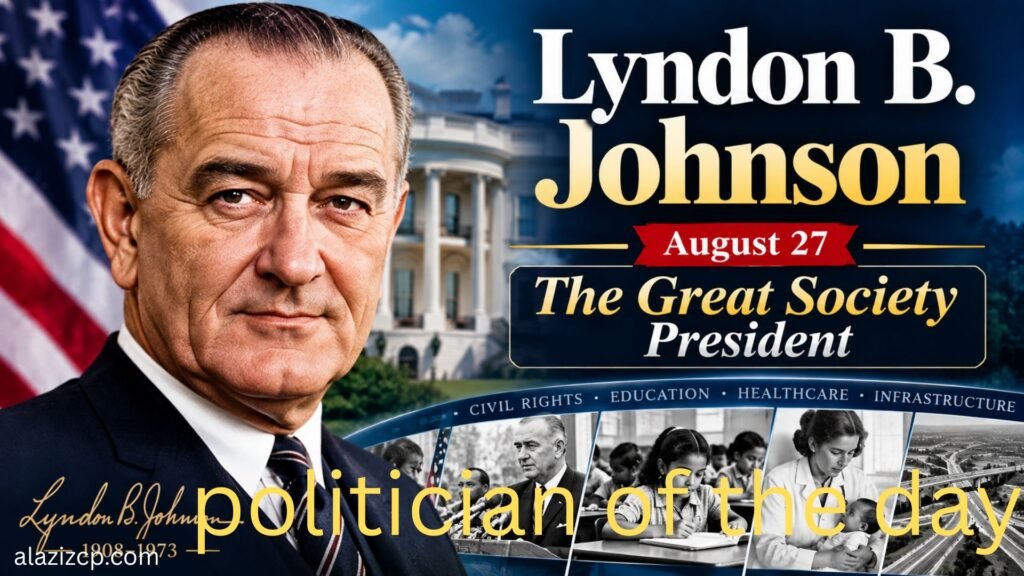
Few presidents arrived in the White House carrying as much political muscle as Lyndon Baines Johnson, and even fewer left behind a legacy so tangled between triumph and controversy. Born on August 27, 1908, near Stonewall, Texas, LBJ grew up in the rugged Texas Hill Country, an upbringing that shaped his relentless, deal making approach to politics for the rest of his life.
Long before reaching the presidency, Johnson built one of the most formidable careers in Congress, first as a U.S. Representative and later as a masterful Senate Majority Leader known for his uncanny ability to twist arms and broker deals that others thought impossible. That legislative skill became his greatest weapon once he assumed the presidency in 1963 following the assassination of John F. Kennedy.
As the 36th president, Johnson used his influence to push through some of the most transformative legislation in American history. His Great Society programs expanded federal responsibility for education, poverty, and healthcare, while his signing of the Civil Rights Act of 1964 and the Voting Rights Act of 1965 permanently altered the country’s legal and social landscape.
Yet his presidency was equally defined by the escalating Vietnam War, a conflict that overshadowed his domestic achievements and ultimately convinced him not to seek reelection in 1968. Decades later, Johnson remains one of the most debated figures in American political history, a leader whose bold reforms and painful missteps are still studied side by side in classrooms across the country.
Quick Facts: The Lyndon B Johnson August 27 Milestone
| Key Milestone | Historical Record |
| Date of Birth | August 27, 1908 |
| Place of Birth | Stonewall, Texas |
| Highest Office | 36th President of the United States (1963–1969) |
| Prior Roles | Vice President (1961–1963), Senate Majority Leader (1955–1961) |
| Key Legislation | Civil Rights Act of 1964, Voting Rights Act of 1965, Medicare/Medicaid |
| Political Party | Democratic Party |
Early Life and Rise to Congressional Power
Raised in the Texas Hill Country, Johnson developed an early appreciation for public service and education. He worked his way through Southwest Texas State Teachers College, working as a teacher in an impoverished rural community, an experience that deeply influenced his future political focus on anti-poverty initiatives.
Entering public office in 1937 upon winning a seat in the U.S. House of Representatives, Johnson displayed extraordinary legislative skill. By 1948, he won election to the U.S. Senate, rapidly climbing the leadership ladder to become Senate Majority Leader in 1955. Renowned for his legendary persuasive ability, often termed “The Johnson Treatment,” he mastered congressional strategy, passing complex bills through a deeply divided legislature.

The Presidency and Civil Rights Legislation Beyond the Lyndon B. Johnson August 27 Legacy
Following the tragic assassination of President John F. Kennedy on November 22, 1963, Johnson assumed the presidency during a national crisis. He immediately used his legislative mastery to fulfill Kennedy’s policy agenda while launching his own ambitious domestic program, dubbed “The Great Society.”
Under LBJ’s leadership, Congress passed historic civil rights legislation. He signed the Civil Rights Act of 1964, outlawing racial segregation in public accommodations and employment discrimination. A year later, he signed the Voting Rights Act of 1965, dismantling legal barriers that prevented Black Americans from exercising their constitutional voting rights. These laws marked pivotal victories in the struggle for equality across the United States.
You are reading now at alazizcp.com about Lyndon B. Johnson on August 27.
Domestic Programs, Foreign Policy, and Historical Impact
The Great Society extended far beyond civil rights reform. Johnson declared an unconditional “War on Poverty,” creating Medicare and Medicaid in 1965 to provide healthcare coverage for senior citizens and low-income families. He also established federal funding programs for public education, public broadcasting, and urban development.
However, Johnson’s domestic accomplishments were increasingly overshadowed by foreign policy challenges, particularly the escalation of the Vietnam War. Mounting domestic protests and political division ultimately led him to announce in March 1968 that he would not seek reelection.

Lasting Impact of Lyndon B. Johnson August 27 Story
Lyndon B. Johnson remains a central figure in American history. From his humble Texas origins to the White House, his legislative accomplishments laid the groundwork for modern American social safety nets and civil rights enforcement. Celebrating his birth anniversary on August 27 offers a vital opportunity to examine a presidency that permanently altered the relationship between the federal government and the American public.
You can read tomorrow about an amazing political personality, so keep in touch with us.

Senior Content Editor at AlAzizCP specializing in deep-dive biographies, career financial profiles, and daily updates on American celebrities, politicians, and sports legends. With years of experience researching public records, contract earnings, and media archives, the AlAzizCP editorial team delivers accurate and engaging insights into today’s most influential public figures.