

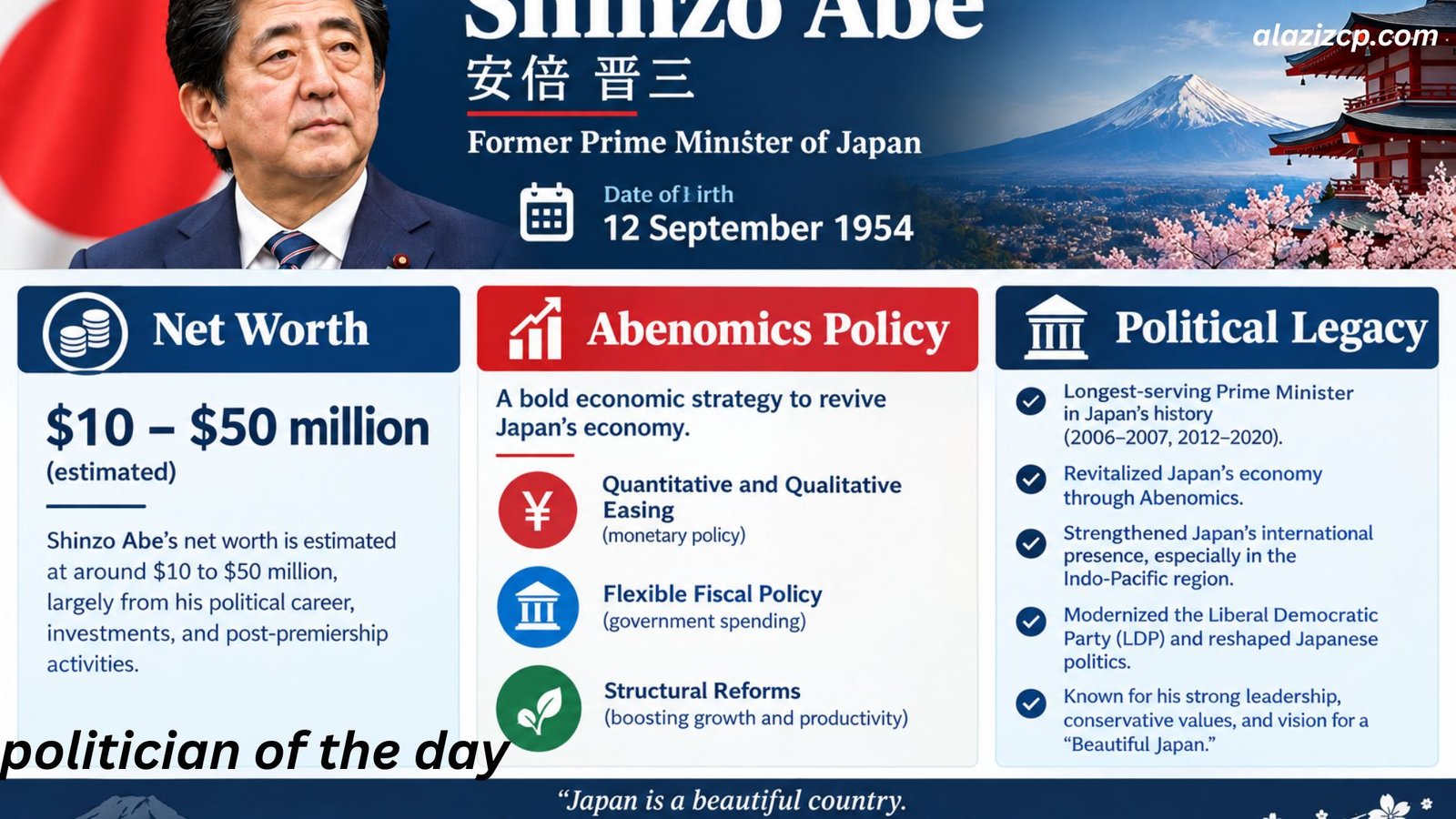
Shinzo Abe net worth
Global political analysts and historians honor the birth anniversary of Shinzo Abe, on 12 September, the transformative statesman who became Japan’s longest-serving prime minister in modern history. Serving as prime minister first from 2006 to 2007 and again in an unprecedented second tenure from 2012 to 2020, Abe fundamentally reshaped Asian geopolitics, domestic monetary policy, and defense strategy.
Understanding Shinzo Abe net worth and his overall estate portfolio provides a fascinating look into the personal finances of Japan’s most influential post-war leader, whose economic blueprint. popularly dubbed “Abenomics”became a global case study in central banking and fiscal stimulus.
Quick Facts: Shinzo Abe Career Summary
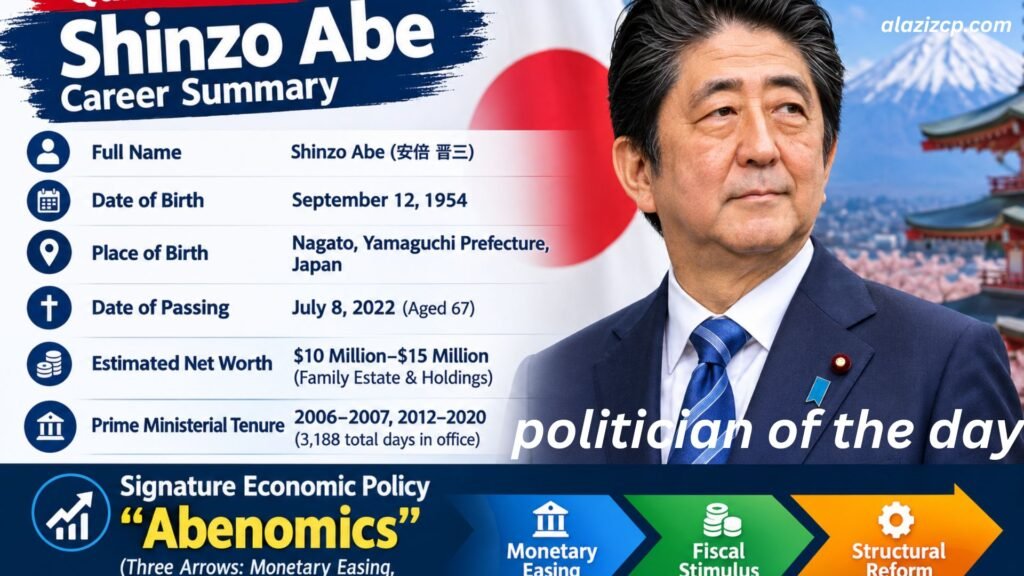
| Political Profile & Detail | Historical Record |
| Full Name | Shinzo Abe (安倍 晋三) |
| Date of Birth | September 12, 1954 |
| Place of Birth | Nagato, Yamaguchi Prefecture, Japan |
| Date of Passing | July 8, 2022 (Aged 67) |
| Estimated Net Worth | $10 Million–$15 Million (Family Estate & Holdings) |
| Prime Ministerial Tenure | 2006–2007, 2012–2020 (3,188 total days in office) |
| Signature Economic Policy | “Abenomics” (Three Arrows: Monetary Easing, Fiscal Stimulus, Structural Reform) |
Political Dynasty and Early Ascent to Power
Born on September 12, 1954, in Tokyo into a prominent Japanese political family, Abe grew up immersed in government affairs. His father, Shintaro Abe, served as Japan’s Foreign Minister, while his grandfather, Nobusuke Kishi, served as Prime Minister in the late 1950s.
After earning a degree in political science from Seikei University in Tokyo and studying public policy at the University of Southern California, Abe gained corporate administrative experience working at Kobe Steel. In 1982, he transitioned into public service as an assistant to his father, learning diplomatic negotiation firsthand.
In 1993, following his father’s passing, Abe won election to the House of Representatives representing Yamaguchi Prefecture’s 1st district. He rose rapidly through the ruling Liberal Democratic Party (LDP), earning national prominence for his firm stance on national security and international diplomacy. In September 2006, at age 52, he became Japan’s youngest post-war Prime Minister.
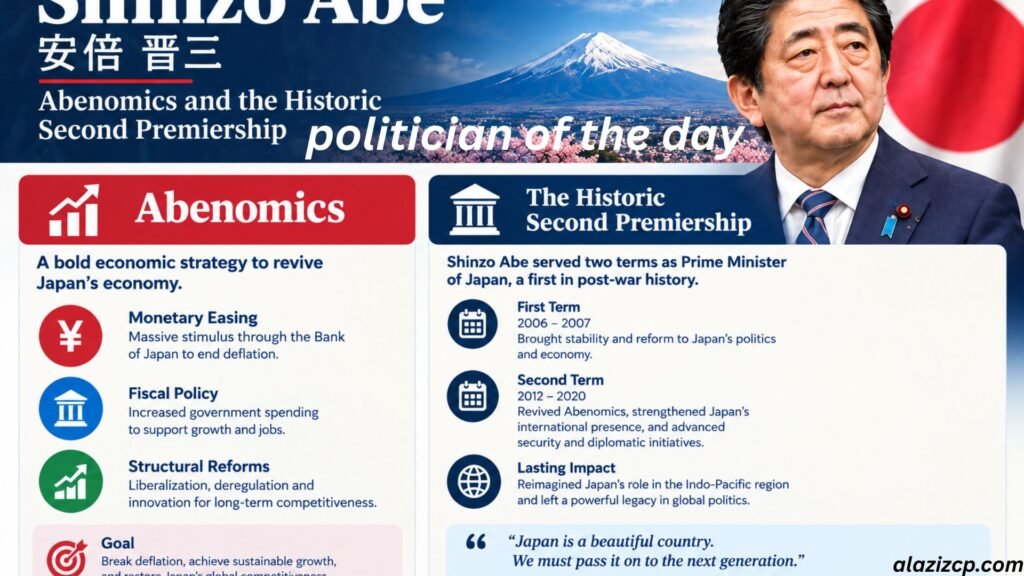
Abenomics and the Historic Second Premiership
After resigning in 2007 due to health complications, Abe staged a remarkable political comeback in December 2012, leading the LDP back to a decisive parliamentary majority. Confronted with decades of economic stagnation and deflation in Japan, he unveiled an aggressive reform package known as Abenomics, built around three core pillars:
- Bold Monetary Policy:
- Partnering with the Bank of Japan to introduce quantitative easing and negative interest rates to combat chronic deflation.
- Flexible Fiscal Policy:
- Deploying state-funded infrastructure investments and economic stimulus packages to boost domestic consumption.
- Structural Reforms:
- Encouraging corporate governance updates, expanding labor force participation through “Womenomics,” and negotiating regional trade agreements like the Comprehensive and Progressive Agreement for Trans-Pacific Partnership (CPTPP).
Internationally, Abe championed the vision of a “Free and Open Indo-Pacific,” building strong bilateral alliances across North America, Europe, India, and Southeast Asia. When he stepped down in August 2020 due to health reasons, he had served 3,188 days as Prime Minister, surpassing all historical records in Japanese governance.
Shinzo Abe Net Worth and Asset Portfolio
When examining Shinzo Abe net worth, official cabinet asset disclosures submitted to Japan’s Ministry of Internal Affairs and Communications, combined with family estate analysis, place his total wealth between $10 million and $15 million.
Unlike political leaders who accumulate private wealth through post-office commercial ventures, Abe’s personal wealth was rooted in established family inheritances and state financial structures:
- Official Cabinet Disclosures:
- During his tenure as prime minister, Abe filed mandatory public asset disclosures reporting personal real estate and financial holdings valued at approximately $1.5 million to $2.5 million, excluding inherited family trust assets.
- Family Real Estate Holdings:
- The Abe family owned high-value residential properties in Tokyo’s prestigious Shibuya district, along with primary estate holdings and ancestral land in Yamaguchi Prefecture.
- Prime Ministerial Compensation:
- Earned a standardized state salary as Prime Minister of approximately 40 million yen (~$370,000 to $400,000 annually), supplemented by parliamentary allowances and state retirement benefits.
- Corporate & Golf Club Securities:
- Held equity shares in domestic Japanese industrial firms and exclusive memberships in top-tier Japanese golf institutions, a staple asset class among senior Japanese diplomats.
Enduring Legacy in Global Geopolitics
Tragically assassinated during a campaign speech in Nara on July 8, 2022, Abe left behind a profound legacy that reshaped 21st-century international diplomacy. Celebrating his September 12 birthday honors a visionary statesman whose economic policies, defense frameworks, and global alliances continue to influence international statecraft today.
Tomorrow we will read about the amazing personality of 13 September

Senior Content Editor at AlAzizCP specializing in deep-dive biographies, career financial profiles, and daily updates on American celebrities, politicians, and sports legends. With years of experience researching public records, contract earnings, and media archives, the AlAzizCP editorial team delivers accurate and engaging insights into today’s most influential public figures.