

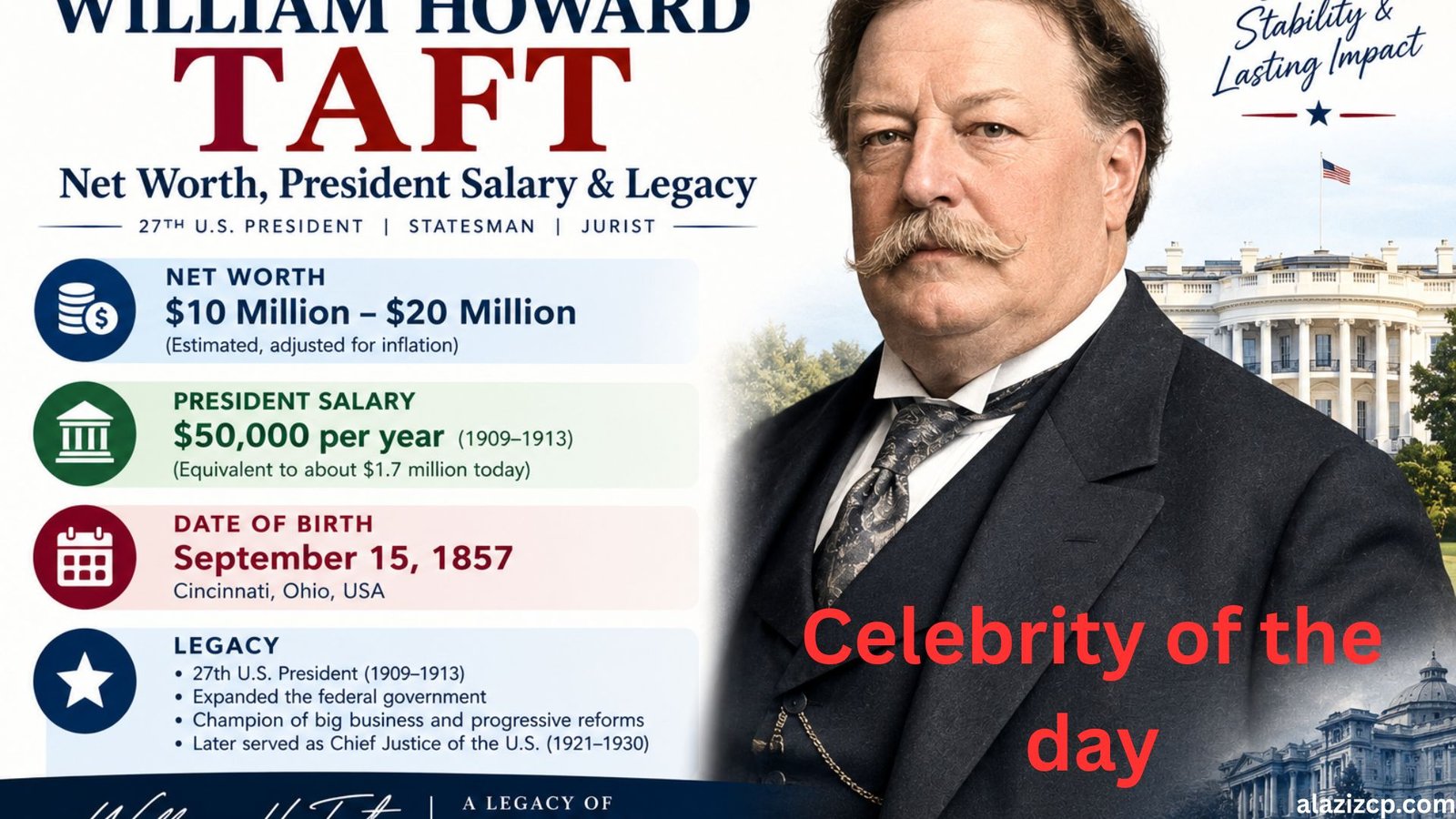
William Howard Taft net worth
Born on 15.09.1857, Taft achieved a singular milestone that remains unmatched in United States history: he is the only person to have served as both the President of the United States (27th) and the Chief Justice of the U.S. Supreme Court (10th).
While modern political discussions often center on contemporary asset disclosures, corporate speaking fees, and multimedia empires, analyzing William Howard Taft net worth, his historic executive salary, and his sweeping economic policies offers a fascinating window into the financial realities of early 20th-century political leadership.
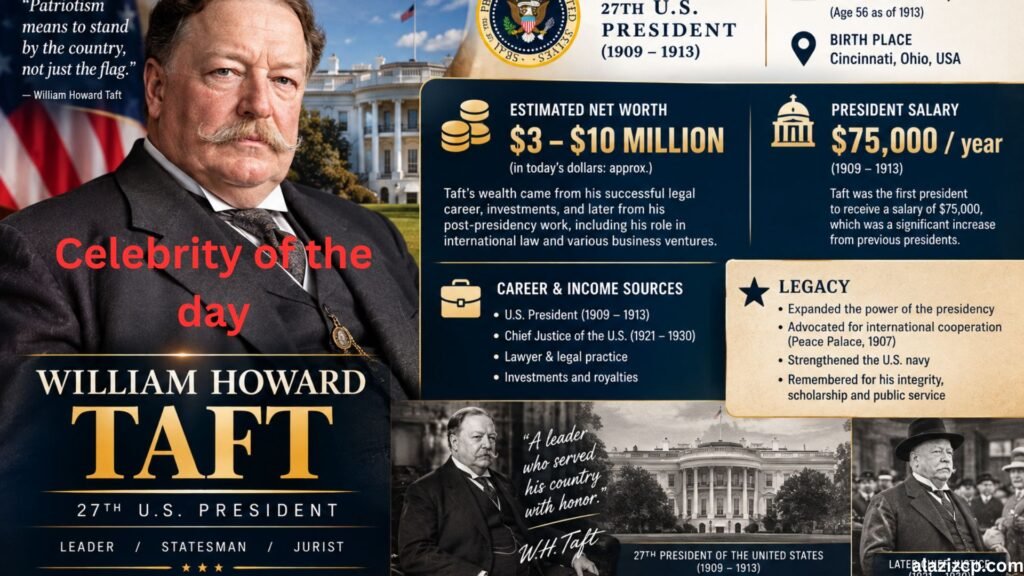
Quick Facts: William Howard Taft Political Profile
| Milestone & Profile | Historical Record |
| Full Name | William Howard Taft |
| Date of Birth | September 15, 1857 |
| Place of Birth | Cincinnati, Ohio, U.S. |
| Presidency | 27th U.S. President (1909–1913) |
| Supreme Court | 10th Chief Justice (1921–1930) |
| Presidential Salary | $75,000 annually (in 1909 dollars) |
| Key Economic Policy | “Dollar Diplomacy” & Corporate Income Tax |
Early Life and Ascent in Public Service. William Howard Taft net worth
Born on September 15, 1857, in Cincinnati, Ohio, William Howard Taft was born into a prominent, politically connected family. His father, Alphonso Taft, served as Secretary of War and Attorney General under President Ulysses S. Grant.
Taft excelled academically, graduating from Yale College, where the jovial, heavyset student was an intramural heavyweight wrestling champion, and later earning his law degree from the University of Cincinnati. His legal acumen propelled a rapid ascent through the judicial and executive ranks. Taft served as an Ohio judge, U.S. Solicitor General, and a federal appellate judge before reaching middle age.
His career shifted dramatically when President William McKinley appointed him Governor-General of the Philippines in 1900, followed by President Theodore Roosevelt appointing him Secretary of War in 1904. Roosevelt heavily groomed Taft as his successor, culminating in Taft’s victorious 1908 presidential campaign against Democratic challenger William Jennings Bryan.
Presidential Salary and “Dollar Diplomacy”
When Taft assumed the presidency in 1909, the financial compensation for the Commander-in-Chief was significantly different than in the modern era. Taft received a base presidential salary of $75,000 per year. a sum that Congress had recently raised, granting him immense purchasing power in the early 1900s economy.
During his single term (1909–1913), Taft’s administration fundamentally altered the American economic landscape. His approach to foreign affairs was famously dubbed “Dollar Diplomacy.” Rather than relying solely on military force, Taft sought to expand American influence abroad by guaranteeing loans to foreign countries, particularly in Latin America and East Asia. This strategy was designed to stimulate international trade, boost American corporate growth, and create regional economic stability.
Furthermore, Taft’s domestic economic policies left an indelible mark on U.S. taxation. He championed the nation’s first corporate income tax, which raised over $13 million in federal revenue. He also strongly supported the passage of the 16th Amendment to the Constitution, which laid the legal groundwork for the modern federal income tax system.
William Howard Taft Net Worth and Family Wealth
Evaluating William Howard Taft net worth requires understanding the era’s financial structures. Unlike modern politicians who often leverage their platform for massive independent wealth, Taft’s financial foundation was closely tied to his elite family network.
Historical records indicate that Taft was largely unconcerned with independently amassing a massive personal fortune. During his early diplomatic and political career, his extensive travel and high-society lifestyle in Washington, D.C., were heavily subsidized by his affluent brother, Charles Phelps Taft. Charles, who married a wealthy Ohio heiress, provided William with substantial financial backing, including gifting him 1,000 lucrative shares in the Cleveland Gas Company to ensure his brother could maintain a lifestyle suitable for his high-ranking positions.
While Taft did not leave behind a modern billionaire’s estate, his financial security was firmly guaranteed by his continuous elite government service and his family’s considerable corporate assets.
The Supreme Court: A Lifelong Ambition
Taft’s presidency ended after one term, following a bitter 1912 election where Theodore Roosevelt formed the progressive “Bull Moose” Party. The maneuver split the Republican voting base, handing the victory to Democrat Woodrow Wilson.
However, the White House was never Taft’s ultimate goal. In 1921, President Warren G. Harding appointed Taft to his absolute dream job: Chief Justice of the United States. Serving in this role until shortly before his death on March 8, 1930, Taft earned a chief justice salary that started at $15,000 and was later increased.
His legacy on the Court was profound. Taft successfully lobbied Congress to pass the Judiciary Act of 1925, which gave the Supreme Court greater control over its docket, allowing it to focus on cases of national constitutional importance. He also secured the federal funding to construct the current U.S. Supreme Court Building, ensuring the judicial branch had a physical architectural presence equal to the executive and legislative branches.
Contextual Internal Links & Related Daily Profiles
To explore other prominent global leaders, entertainers, and athletes featured during this publishing window on alazizcp.com, review our companion daily profiles:
- Read about Oscar-nominated actor Tom Hardy’s cinematic earnings in our September 15 Celebrity Profile.
- Learn about hip-hop legend Nas’s venture capital portfolio in our September 14 Celebrity Profile.
- Review German football legend Thomas Müller’s career earnings in our September 13 Athlete Profile.
An Unmatched Dual Legacy
Celebrating his September 15 birthday honors a statesman who shaped both the executive and judicial branches of the United States. William Howard Taft’s legacy is not just defined by his historical political records but by the lasting economic frameworks from early corporate taxation to global trade diplomacy. that he helped establish for the modern era.

Senior Content Editor at AlAzizCP specializing in deep-dive biographies, career financial profiles, and daily updates on American celebrities, politicians, and sports legends. With years of experience researching public records, contract earnings, and media archives, the AlAzizCP editorial team delivers accurate and engaging insights into today’s most influential public figures.