

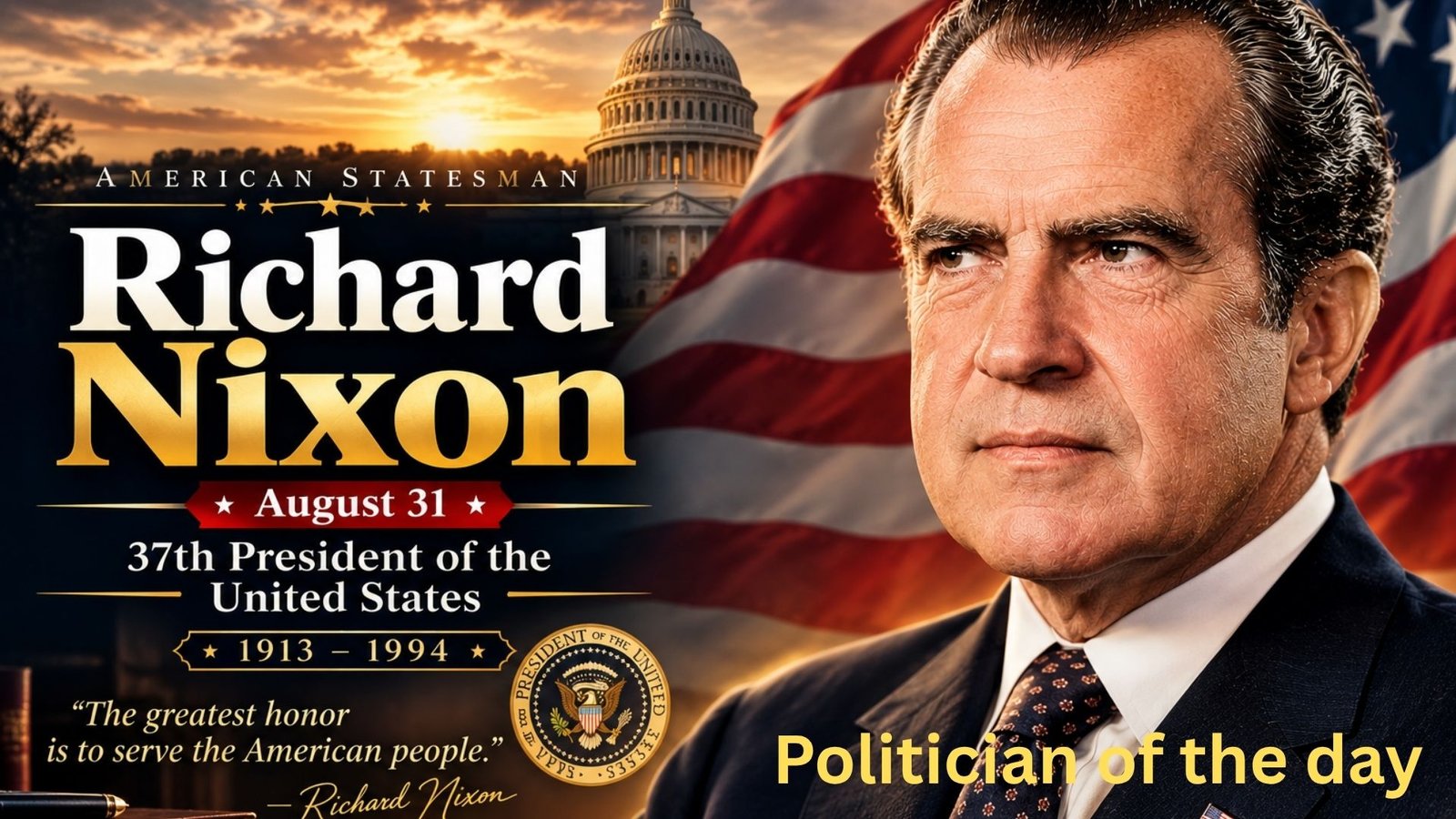
Richard Nixon August 31
As the 37th President, Nixon left a complicated but undeniably significant mark on the country. He opened diplomatic relations with China, pursued detente with the Soviet Union, and created the Environmental Protection Agency, moves that reshaped both foreign policy and domestic governance for decades to come.
Born on August 31, 1913, in the small farming town of Yorba Linda, California, Richard Nixon grew up in modest circumstances that later shaped his relentless drive for success. Long before reaching the White House, he built one of the most extensive political resumes in American history, serving as a U.S. Representative, a U.S. Senator, and then two terms as Vice President under Dwight D. Eisenhower.
His path to the presidency wasn’t a straight line. After a narrow and painful loss to John F. Kennedy in 1960, many assumed his political career was finished. Yet Nixon rebuilt his image over the following years, eventually winning the presidency in 1968 during one of the most turbulent periods in modern American history.
Quick Facts: The Richard Nixon August 31 Milestone
| Key Milestone | Historical Record |
| Date of Birth | August 31, 1913 |
| Place of Birth | Yorba Linda, California |
| Key Political Roles | U.S. Congressman, U.S. Senator, 36th Vice President, 37th U.S. President |
| Major Diplomatic Feat | Historic 1972 Visit to the People’s Republic of China |
| Key Domestic Policy | Establishment of the Environmental Protection Agency (EPA) |
| Political Party | Republican |
Early Life and Political Rise
Nixon grew up in working-class circumstances in Southern California, developing a strong work ethic that carried him through Whittier College and Duke University School of Law. After serving as a U.S. Navy officer during World War II, he entered national politics in 1946 by winning a seat in the U.S. House of Representatives.
Nixon rapidly gained national recognition for his analytical mind and sharp debating skills. By 1950, he was elected to the U.S. Senate, and just two years later, at age 39, General Dwight D. Eisenhower selected him as his vice-presidential running mate. Nixon served eight years as vice president, handling crucial diplomatic missions across Asia, Europe, and Latin America.
Presidential Breakthrough and Foreign Policy Mastery
After a narrow loss in the 1960 presidential election, Nixon executed one of the greatest political comebacks in American history by winning the presidency in 1968. Assuming office during a period of intense social unrest and cold war tensions, Nixon prioritized global diplomacy and statecraft.
In February 1972, Nixon achieved a monumental foreign policy breakthrough by becoming the first sitting U.S. President to visit the People’s Republic of China. This historic diplomatic trip opened official relations between the two nations and altered the global geopolitical balance. Shortly thereafter, he traveled to Moscow to sign the Strategic Arms Limitation Talks (SALT I) treaty with the Soviet Union, initiating a period of détente.
Domestic Environmental and Social Reforms
While best remembered for foreign affairs, Nixon’s administration enacted far-reaching domestic legislation. In 1970, he established the Environmental Protection Agency (EPA) and signed the Clean Air Act into law, creating the modern framework for environmental protection in the United States.
His administration also oversaw the desegregation of southern public schools, established the Occupational Safety and Health Administration (OSHA), and signed the Title IX legislation that expanded female participation in higher education and sports.
Lasting Impact of the Richard Nixon August 31 Story
Nixon resigned the presidency in August 1974 following the Watergate political crisis, ending a tumultuous chapter in American history. In the decades following his presidency, historians and foreign policy scholars have continued to analyze his strategic intellect and diplomatic vision. Celebrating the Richard Nixon August 31 milestone reflects on a presidency whose diplomatic legacies continue to shape international relations today.

Senior Content Editor at AlAzizCP specializing in deep-dive biographies, career financial profiles, and daily updates on American celebrities, politicians, and sports legends. With years of experience researching public records, contract earnings, and media archives, the AlAzizCP editorial team delivers accurate and engaging insights into today’s most influential public figures.