

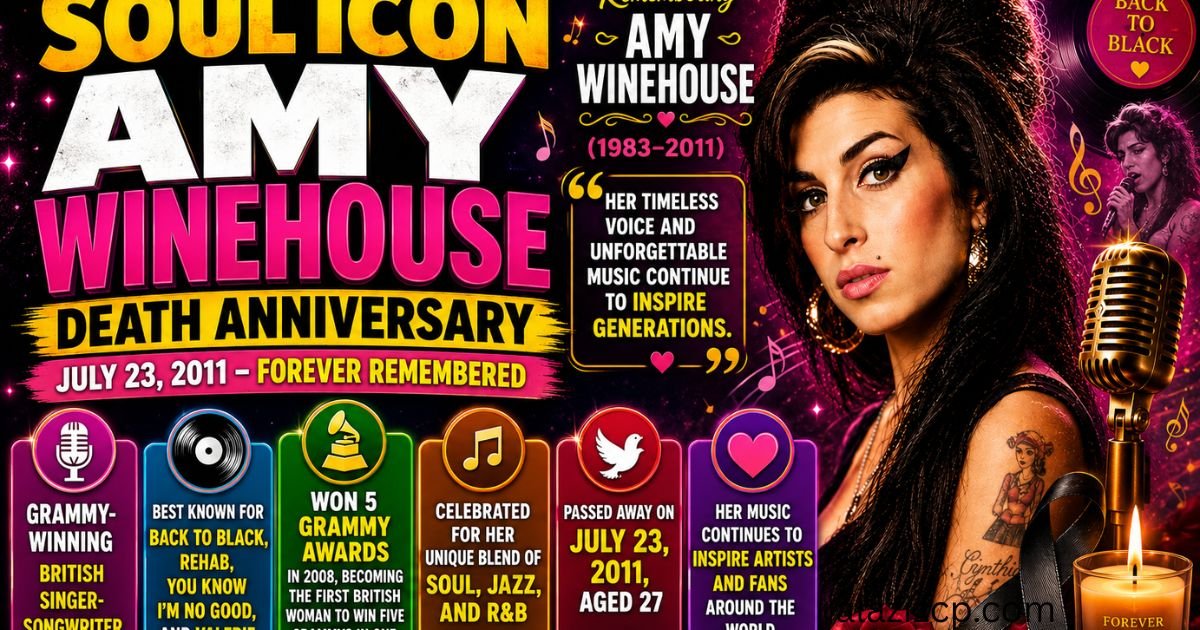
If I Remember fifteen years ago today,Amy Winehouse death anniversary on July 23, 2011, a 27 year old British singer was found dead in her North London flat, surrounded by empty vodka bottles. Amy Winehouse’s death shocked the music world, not because it was entirely unexpected but because so many people had spent years hoping she’d somehow pull through.
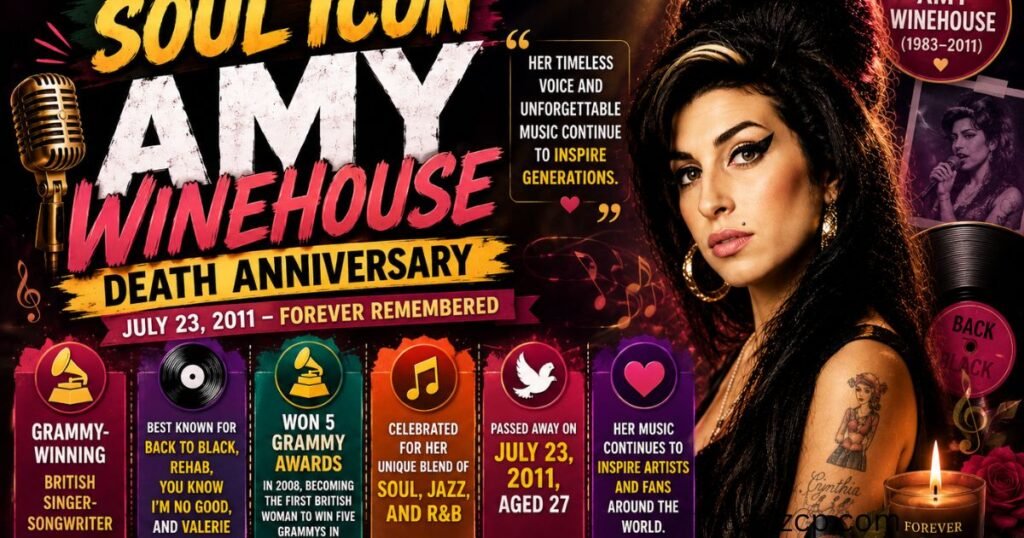
Winehouse was born in London in September 1983, and by her early twenties she’d already built a reputation as one of the most distinctive voices of her generation, a mix of old school jazz phrasing with a rawness that felt completely modern. Her 2003 debut album, Frank, earned strong reviews, but it was 2006’s Back to Black that changed everything. Produced by Mark Ronson and Salaam Remi, the album blended retro soul and Motown influences with lyrics so personal they felt almost uncomfortable to listen to, and it turned her into an international star almost overnight.
The height of her career and the height of her struggles arrived at more or less the same time. At the 2008 Grammy Awards, Winehouse performed via satellite from London, since visa issues kept her from traveling to Los Angeles, and still walked away with five awards that night, tying the record for most wins by a female artist in a single ceremony. Her signature song “Rehab,” ironically, took home Song of the Year, Record of the Year, and Best Female Pop Vocal Performance.
That irony wasn’t lost on anyone. Winehouse had been open, sometimes almost defiantly so, about her addiction issues, and “Rehab” itself was written about her real-life refusal to seek treatment. She eventually did go, more than once, and by the final years of her life she’d actually managed to get clean from hard drugs. Friends and family have said she was making genuine progress with her alcoholism too. It was a relapse, not a steady decline, that ultimately took her life. keep in touch with us .
The official cause of death, confirmed by a coroner a year and a half later, was alcohol toxicity. Her blood alcohol level was measured at more than five times the legal driving limit in the UK, high enough that the coroner described it as well beyond a fatal threshold. Her death placed her in what’s often called the 27 Club, a grim shorthand for musicians who died at that exact age, alongside names like Jimi Hendrix, Janis Joplin, and Kurt Cobain.
Her father, Mitch Winehouse, has spent years since her death trying to make sure people remember more than just the tabloid version of her story. He described her to People magazine as a loyal and generous friend who saw the best in everybody, a description that doesn’t often make it into the headlines about her final years. The family went on to establish the Amy Winehouse Foundation, which now funds music therapy and a recovery house for young people dealing with addiction, turning her story into something that continues to help others.
Musically, her influence hasn’t faded at all. A posthumous duet with Tony Bennett, “Body and Soul,” won a Grammy after her death, and the 2015 documentary “Amy” went on to win the Academy Award for Best Documentary, introducing her story to an entirely new generation of listeners who’d never seen her perform live.
Fifteen years later, Back to Black is still considered one of the defining albums of the 2000s, and Winehouse’s voice remains instantly recognizable to anyone who’s ever heard it once.

Senior Content Editor at AlAzizCP specializing in deep-dive biographies, career financial profiles, and daily updates on American celebrities, politicians, and sports legends. With years of experience researching public records, contract earnings, and media archives, the AlAzizCP editorial team delivers accurate and engaging insights into today’s most influential public figures.